
Setting up an indoor garden starts with one critical decision: choosing the right grow tent sizes for your goals. Too small, and your plants compete for light and air. Too large, and you waste energy heating and cooling empty space. The sweet spot depends on how many plants you want, your strain type, and your experience level.
This guide walks you through the most popular grow tent dimensions, the plant counts each one supports, and the exact Mars Hydro equipment that pairs with each size. Whether you’re a beginner starting with a few herbs or a serious hobbyist planning a full flowering room, you’ll learn what fits without overspending.
Let’s start with the smallest setups and work up to professional-grade configurations so you can build your grow room with confidence.
2×2 Grow Tent: Compact Starter Setup

A 2×2 grow tent fits in closets, on countertops, or inside spare corners. It is the smallest practical size for a real indoor garden.
Best Plant Count for a 2×2 Tent
Stick to 1 to 2 plants maximum. One mature plant fits comfortably, or you can run two small seedlings or clones. This size works well for mother plants, early vegetation, or testing new genetics before scaling up.
Recommended Lighting and Airflow
The Mars Hydro FC 1500 delivers even light distribution across the full floor without hotspots. Pair it with a 4-inch inline fan for exhaust and one clip fan at canopy level to keep air moving. Even a tiny tent needs airflow to prevent mold and strengthen stems.
Pro Tip: Add the iControl system to monitor temperature and humidity. Conditions shift fast in tight spaces, and remote alerts help you catch problems early.
3×3 Grow Tent: Balanced Hobbyist Size

A 3×3 grow tent gives you more room to train and flower plants while staying manageable for a single grower.
Plant Capacity in a 3×3 Tent
You can grow 2 to 4 plants comfortably. Use Low-Stress Training (LST) to open up the canopy and maximize light exposure. Avoid SCROG nets unless you’re running a single plant, since crowding leads to humidity spikes.
Lighting and Climate Setup
The Mars Hydro FC 3000 covers the entire footprint with uniform PPFD output. It runs cool enough for passive intake in many setups. Pair it with a 4-inch inline fan, one clip fan, and a sensor kit linked to iControl for real-time temperature and humidity alerts.
Avoid This Mistake: Loading 5 or more plants into a 3×3 tent causes poor airflow and invites bud rot. Stick to 4 or fewer.
2×4 Grow Tent: Narrow and Efficient
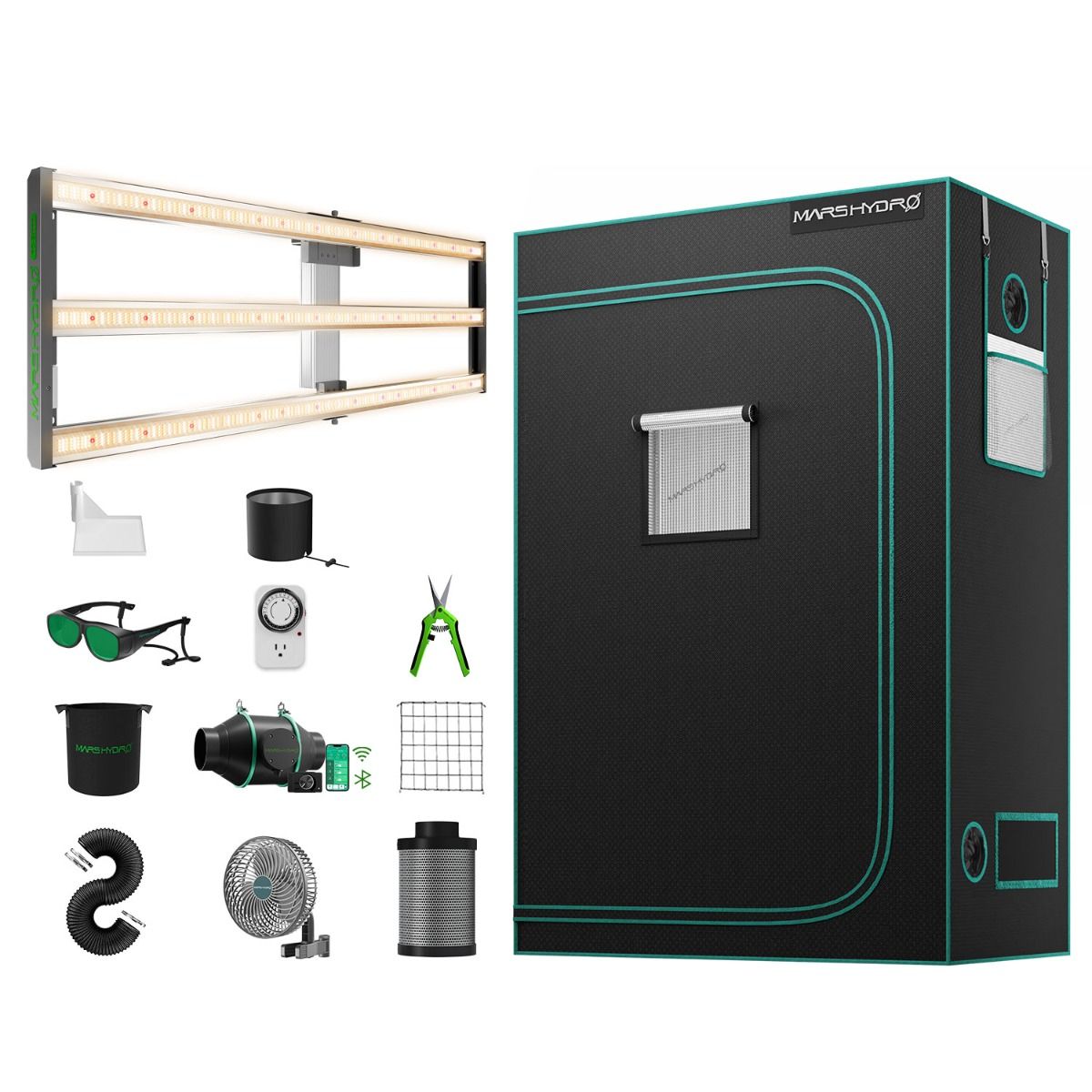
A 2×4 grow tent fits along walls, inside closets, or in any narrow spot where square tents won’t work.
How Many Plants Fit in a 2×4 Tent
This tent supports 3 to 4 plants arranged in a single row. It is ideal for Sea of Green (SOG) with smaller, bushier strains. Each plant gets equal light access when lined up properly.
Lighting and Airflow Configuration
The Mars Hydro FC 4000 is engineered for this exact footprint. Hang it centered, or shift it slightly forward to kill shadow zones at the far ends. Use a basic 4-inch inline fan paired with a clip fan at canopy height. Position intake low and exhaust high to take advantage of natural convection.
Expert Note: A 2×4 tent often outperforms square tents of similar square footage because the rectangular shape uses space more productively.
4×4 Grow Tent: The Home Grow Standard
A 4×4 grow tent is the gold standard for serious home growers. It offers 16 square feet of growing space, which is enough to produce a meaningful harvest without industrial complexity.
Plant Count and Training Methods
You can fit 4 to 6 plants with room to train them. Use SCROG nets or topping to create flat, even canopies. This maximizes light penetration and boosts yield per plant significantly.
Full Setup for Maximum Yield
The Mars Hydro FC 4800 covers the full 16 square feet with high-output intensity. It handles dense canopies during flowering and runs efficiently on standard 18/6 or 12/12 light cycles. Upgrade your airflow to a 6-inch inline fan plus two clip fans (one above canopy, one below) for complete air exchange.
For automation, add:
- ADlite to manage CO₂ and lighting schedules
- A humidifier to maintain moisture in dry climates
- iHub Pro to integrate all devices into one app
- Drip irrigation with auto-drainage to reduce daily labor
Time Saver: Set your timers once and let the system run. This is perfect for growers with busy schedules.
5×5 Grow Tent: High-Density Harvest Zone

A 5×5 grow tent gives you 25 square feet, which is enough for bigger yields without jumping into full commercial territory.
Plant Capacity and Spacing
This tent holds 6 to 8 plants with strategic spacing. Use SCROG or super cropping to control stretch during flowering. Rotate pots weekly so all plants get even light exposure.
Lighting Options for a 5×5 Tent
The Mars Hydro FC 6500 offers two placement options:
- One FC 6500 centered for full coverage with 6 plants
- Two FC 6500s side-by-side for maximum intensity with 8 or more plants
Pair this with dual clip fans placed diagonally to create cross-breeze. Stagnant air pockets attract pests, so movement matters.
For environmental control, add ADlite for CO₂ and light automation, a large humidifier to maintain 50–60% RH, drip irrigation with auto-drain, and iHub Pro for full system integration.
Warning: High-wattage lights build heat fast. Without strong airflow, your canopy temperature can spike within minutes.
4×8 Grow Tent: Scaling Up Linearly
A 4×8 grow tent doubles the length of a 4×4, giving you 32 square feet split into two distinct zones.
How Many Plants Fit in a 4×8 Tent
You can run 12 to 18 plants by dividing the tent into two 4×4 sections. Use SCROG or SOG depending on strain size to keep canopies uniform across both zones.
Lighting and Airflow Setup
Place two FC 4800 lights, one centered over each 4×4 section. Stagger hanging heights if needed to eliminate shadows in the middle of the tent. Use a high-CFM 6-inch inline fan plus multiple clip fans. Set up intake at one end and exhaust at the other to create a clear air path.
Link your iHub Pro to a sensor network that monitors both ends of the tent. This catches microclimate differences before they stress your plants.
Pro Move: Run lights on alternating schedules (such as 6/18 and 18/6) to cut peak energy draw and reduce heat load during the day.
5×10 Grow Tent: Large Home Grow Capacity
A 5×10 grow tent approaches commercial scale, with 50 square feet of growing space. It is ideal for experienced growers planning pre-licensed production or large personal harvests.
Plant Capacity and Zoning
This tent supports 14 to 24 plants when split into two 5×5 zones. You have space to run different strains or stagger vegetative and flowering cycles for continuous harvests.
Full Equipment Configuration
Center one FC 6500 over each 5×5 zone. Adjust hangers weekly to track plant height and prevent uneven growth. Use dual inline fans (one per zone) and multiple oscillating clip fans at different heights.
Larger spaces dry out fast, so add a 15L humidifier to maintain stable humidity. Complete the setup with:
- ADlite for CO₂ and light automation
- iHub Pro for app-based remote monitoring
- Drip irrigation with timers and auto-drain for hands-off feeding
Key Benefit: At this size, full automation becomes practical. You can minimize daily hands-on time significantly.
8×8 Grow Tent: Professional-Grade Setup
An 8×8 grow tent delivers 64 square feet of growing space, which represents the upper limit for serious home cultivation before stepping into commercial infrastructure.
Maximum Plant Count
You can run 16 to 36 plants in a grid layout (either 4×4 or 6×6 patterns). Use vertical SCROG or trellising to take advantage of ceiling height.
Lighting and Airflow at Scale
Space four FC 4800 lights in a 2×2 grid pattern. Maintain 18–24 inches of distance from the canopy and rotate light positions monthly for uniform growth. Install 2 to 3 inline fans (split between intake and exhaust) plus multiple clip fans. Use ducting to direct airflow and eliminate hotspots.
For full smart control, add:
- ADlite for CO₂, light, and fan automation
- An industrial humidifier to stabilize humidity
- iHub Pro for remote monitoring via smartphone
- Drip irrigation with auto-drain and reservoir monitoring for zero-touch feeding
Expert Tip: Add a backup power supply and temperature alarm. At this scale, a single equipment failure can cost thousands in lost yield.
How to Choose the Right Grow Tent Size
Match Tent Size to Your Plant Count Goals
Use this quick reference when planning:
- 1 to 4 plants: 2×2 to 3×3 tent
- 4 to 8 plants: 4×4 to 5×5 tent
- 12 or more plants: 4×8 and larger
If you’re new to growing, start small. Master climate control before scaling up.
Consider Strain and Training Method
Different strains need different tent shapes:
- Tall sativas: Need ceiling clearance (78 inches or more)
- Indicas and bushies: Fit more plants across width
- SCROG and LST: Reduce plant count to boost yield per plant
Prioritize Climate Control
Bigger tents demand stronger airflow. Always size your inline fan to exceed the tent’s volume. A simple rule: target CFM greater than the tent’s total cubic feet for fast air exchange.
Plan for Equipment Space
Lights, filters, and ducting eat into your headroom. Leave at least 6 to 12 inches of clearance above your light fixture for heat dissipation and adjustment room.
Common Mistakes to Avoid When Choosing Grow Tent Sizes
Overcrowding Plants
More plants do not mean more yield. Crowding cuts airflow, raises mold risk, and blocks light from reaching lower bud sites.
Underpowered Lighting
Weak lights create stretchy, thin plants that produce airy flowers. Match wattage to tent size:
- 2×2 tent: 150 to 250W
- 4×4 tent: 400 to 600W
- 8×8 tent: 1200 to 1600W
Ignoring Air Exchange
Aim for full air replacement every 3 to 5 minutes. Calculate your minimum CFM by dividing tent volume by 3. A 4×4 tent with 7-foot walls equals 112 cubic feet, so you need at least 37 CFM of exhaust.
Skipping Automation
Manual monitoring fails when you’re away. Use iHub Pro or similar controllers for instant alerts on temperature spikes, humidity drops, or power outages.
Frequently Asked Questions About Grow Tent Sizes
What is the most popular grow tent size for beginners?
The 4×4 grow tent is the most popular size for serious beginners. It balances yield potential with manageable climate demands and fits standard spare rooms. Smaller 2×2 or 3×3 tents also work well for absolute first-timers with limited goals.
How many plants can I grow in a 4×4 tent?
A 4×4 tent supports 4 to 6 plants comfortably, depending on strain and training method. With SCROG netting, experienced growers can push this to 9 or more smaller plants. Without training, stick to 4 to 6 for best results.
What size tent do I need for 12 plants?
A 4×8 tent is the right size for 12 to 18 plants. It splits cleanly into two 4×4 zones, making it easy to run two separate light cycles or strain types. A 5×5 tent also works for exactly 12 plants in a denser layout.
How do I calculate fan size for my grow tent?
Multiply length × width × height to get total cubic feet, then divide by 3. That gives you the minimum CFM (cubic feet per minute) your inline fan should move. For example, a 4×4×7 tent equals 112 cubic feet, requiring at least 37 CFM.
Can I use one grow tent for both veg and flower?
Yes, many growers use one tent with adjustable light schedules. Run 18 hours of light for vegetative growth, then switch to 12 hours for flowering. Larger sizes like 5×10 or 8×8 let you split the tent into two zones with separate cycles for continuous harvest.
Key Takeaways for Choosing the Right Grow Tent Size
Selecting the right grow tent sizes comes down to three factors: your target plant count, your strain type, and your climate control capacity. Match the tent footprint to your plant count using the guidelines above, then pair it with appropriately sized lighting and airflow equipment.
Start by measuring your available room and identifying your goal plant count. From there, pick the smallest tent that fits your goals. You can always scale up later, but oversizing your first setup leads to wasted energy and harder climate control.
Build smart from the start, and your harvest will reflect the effort you put into planning.