
You lace up your boots, hit the trail, and breathe in the fresh air. It feels more like adventure than exercise—but make no mistake: hiking burns calories, often far more than you’d guess. Whether you’re tackling a steep mountain path or strolling through wooded hills, your body is working hard—burning energy with every step.
So, does hiking burn calories? Absolutely. And depending on your weight, terrain, pack load, and trail conditions, you could torch anywhere from 300 to over 600 calories per hour—with extreme hikes pushing totals past 1,500+ calories in a single outing.
This isn’t just about weight loss. Understanding how hiking burns calories helps you fuel safely, prevent burnout, and maximize health benefits. In this guide, you’ll learn exactly how many calories hiking burns, what factors boost it, how it compares to running and walking, and why underestimating your burn can be dangerous—especially on long trails.
Let’s break down the science so you can hike smarter, stronger, and safer.
Steeper Grades Burn More Energy Than Flat Trails

The incline of your trail is one of the biggest drivers of calorie expenditure.
- 1%–5% grade (gentle slope): Similar to brisk walking—moderate burn.
- 6%–15% grade (moderate to steep): Increases calorie burn by up to 50%.
- Grades over 35% (rare but possible): Drastically increase effort and energy use.
Example: A 150-pound hiker burns about 360 kcal/hour on mild terrain but 544 kcal/hour on steeper slopes—184 extra calories per hour just from elevation.
Even small climbs add up. Over a 6-mile hike with 2,500 feet of elevation gain, that same hiker burns 924 kcal going up, compared to just 533 kcal descending.
Hiking uphill forces your glutes, quads, and calves to work harder, while your heart and lungs pump faster to deliver oxygen. The steeper the grade, the more your body recruits stabilizing muscles to maintain balance—further increasing energy demand.
Rugged Terrain Engages More Muscles and Burns More Calories
Unlike pavement, trails are unpredictable. Rocks, roots, mud, and loose gravel force constant balance adjustments.
This activates:
– Stabilizing muscles in ankles, hips, and core
– Glutes and calves with every uneven step
– Smaller neuromuscular pathways for coordination
Result? More muscle recruitment = higher calorie burn, even at slower speeds.
One hiker put it simply: “Two miles on a trail is a LOT different than walking two miles on a sidewalk.”
On flat ground, your stride is predictable. On trails, each step requires micro-corrections. That constant engagement turns hiking into a full-body workout—even without weights or speed.
Elevation Gain Multiplies Effort and Total Calorie Burn

Total vertical gain matters more than distance alone.
- Each 1,000 feet of elevation gain significantly increases energy cost.
- A 12-mile hike with 2,500 ft of climbing burns nearly 1,574 kcal (with a pack).
- Thru-hikers on the Appalachian Trail average 300–500 kcal/hour, burning 6,000+ kcal per day.
The body works harder to lift mass uphill—especially when fatigued later in the hike. And while descending seems easier, it still demands muscle control to stabilize joints, especially with a heavy pack.
Pro tip: When calculating your burn, focus on elevation gain, not just distance. A 5-mile hike with 2,000 feet of climbing burns far more than a 7-mile flat trail.
Heavier Hikers Burn More Calories—And So Do Those Carrying Packs
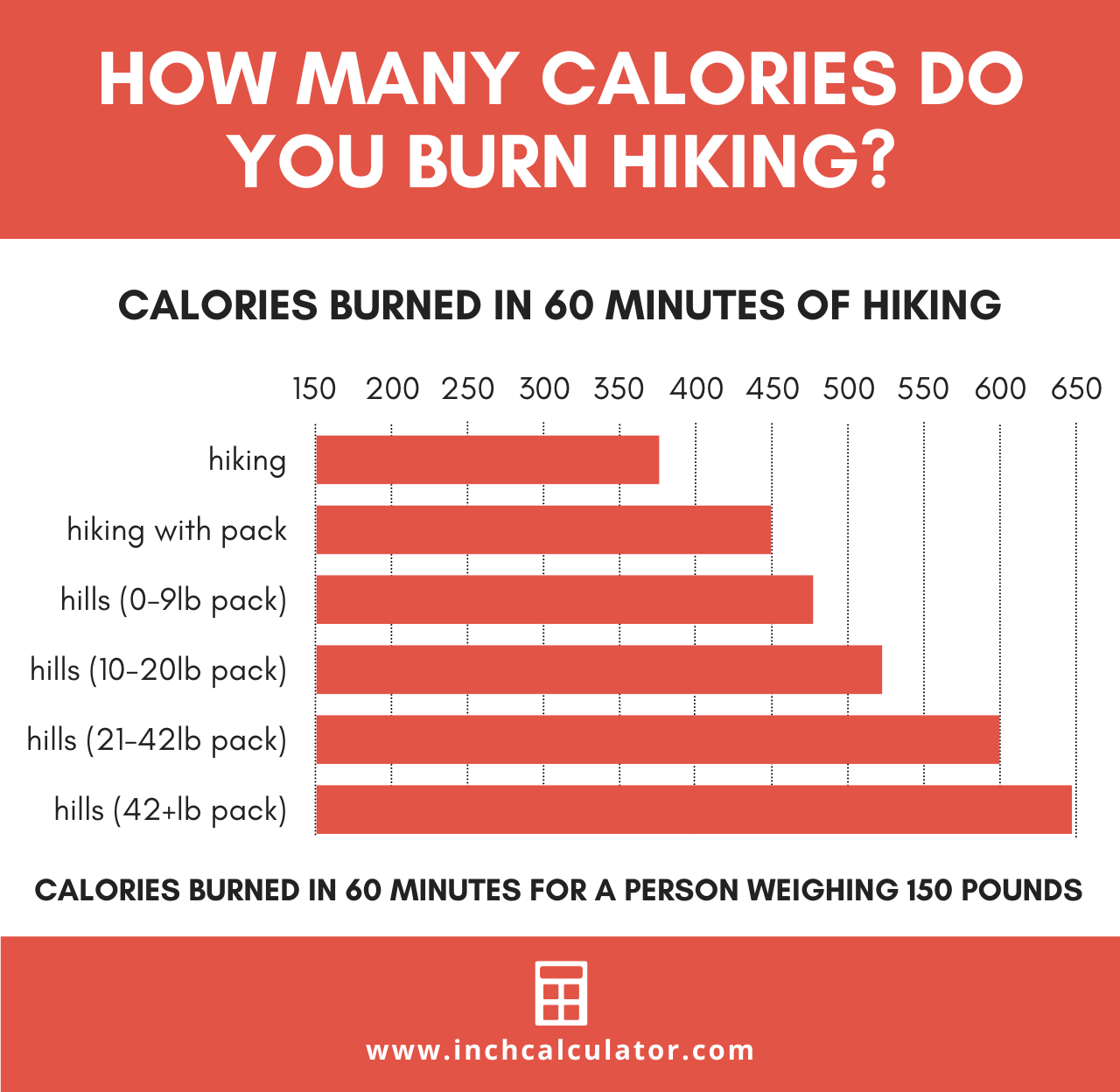
Your personal stats and gear load directly impact how many calories you burn. Heavier bodies and heavier packs mean more work—and more calories burned.
Heavier Hikers Burn More Calories Per Hour
Because moving mass requires energy, body weight is a primary factor.
| Weight | Calories/Hour (6%–15% Grade) |
|---|---|
| 120 lb | 440 kcal |
| 150 lb | 544 kcal |
| 180 lb | 656 kcal |
| 210 lb | 760 kcal |
| 240 lb | 872 kcal |
| 270 lb | 984 kcal |
A 200-pound person burns about 550 kcal/hour—200 more than a 120-pound hiker on the same trail.
This doesn’t mean heavier people are “less fit.” It means they naturally expend more energy moving their bodies uphill.
Backpack Weight Adds Significant Caloric Demand
Carrying a pack increases calorie burn by 50–300 kcal/hour, depending on weight.
- 10–25 lb packs are common for day hikes and overnight trips.
- A 18 lb pack added 74.5 kcal during ascent and 42.5 kcal during descent in one calculation.
- Military load carriage models (like LCDA) confirm: every extra pound increases metabolic demand.
Pro tip: That extra food, water, and gear? It’s helping you burn more—but you’ll need to eat more to keep up.
How Long and Far You Hike Determines Total Calories Burned
Duration and distance determine total calorie burn. Even moderate hourly rates add up over hours.
Average Hiking Speed: 2.9–3.5 mph
Most hikers move slower than runners—but stay out longer.
- A 6-mile hike at 3 mph takes 2 hours.
- At 500 kcal/hour, that’s 1,000 total calories burned.
- A 4-hour hike can easily burn 2,000+ kcal, matching or exceeding intense gym sessions.
Compare that to running: while running burns more per minute, long hikes often surpass total calorie burn due to duration.
Multi-Day Hikes Burn Massive Calories
Thru-hikers on the Pacific Crest Trail (PCT) or Appalachian Trail (AT) burn staggering amounts:
- Daily average: 5,000–6,000 kcal
- Total for PCT (4,270 km): Over 200,000 kcal—equal to nearly 30 lbs of fat
- Despite eating 3,500+ kcal/day, many lose weight and must “gorge” in towns
“I burned about 6,000 calories per day on my AT thru-hike.” – Souvenirs_Indiscrets
Cold Weather and High Altitude Increase Calorie Needs
You burn more calories when the environment fights back. Cold, altitude, and wind all increase your body’s energy needs—even when you’re not moving.
Cold Weather Increases Metabolism
In freezing temps, your body burns extra calories to stay warm.
- At 15–23°F (–9 to –5°C), hikers burn 34% more calories than at 50°F.
- Shivering and non-shivering thermogenesis (internal heat production) ramp up metabolic rate.
- Wet or windy conditions amplify heat loss—and energy cost.
Winter hikers often need 500–1,000+ extra calories per day just to maintain body temperature.
High Altitude Raises Energy Demand
At elevation, your body works harder to get oxygen.
- At 4,300 meters (14,100 ft), basal metabolic rate (BMR) increases by 17–27%.
- One study found 6.9% BMR increase by day 3 at high altitude.
- Hypoxia forces faster breathing and heart rate, increasing caloric needs.
This means you burn more even at rest—and even more while hiking.
How to Calculate Your Hiking Calorie Burn Accurately
Want to know your actual burn? Use a formula or tool that accounts for real trail conditions—not just distance.
Use the MET Formula
The Metabolic Equivalent of Task (MET) system standardizes energy cost.
- 1 MET = resting energy use
- Hiking at 3.5 mph ≈ 5.7 METs
- Uphill hiking (6–15% grade) ≈ 6–8 METs
Formula:
Calories = MET × Weight (kg) × Duration (hours)
Example:
A 75 kg person hiking 1.5 hours at 6 METs:
6 × 1.5 × 75 = 675 kcal
This method is used in research and accurate calculators.
Try a Hiking-Specific Calculator
Generic fitness apps often underestimate hiking calories because they ignore:
– Pack weight
– Elevation gain
– Terrain difficulty
– Temperature
– Altitude
Better tools include:
– nwhiker.com/calorieburn.html
– Omni Hiking Calculator
– Backcountry Foodie Hiking Calorie Calculator (dietitian-designed)
These let you input:
– Body weight
– Pack weight
– Distance
– Elevation gain
– Temperature
– Trail type
Hiking vs. Walking: Why Hiking Wins for Calorie Burn
Hiking burns 20–50% more calories than walking—even at similar speeds.
| Weight | Hiking (3.5 mph, mild grade) | Flat Walking (3 mph) | Brisk Walking (4 mph) |
|---|---|---|---|
| 150 lb | 360 kcal/hr | 238 kcal/hr | 340 kcal/hr |
| 180 lb | 435 kcal/hr | 287 kcal/hr | 451 kcal/hr |
| 210 lb | 504 kcal/hr | 333 kcal/hr | 475 kcal/hr |
Why Hiking Wins:
- Incline: Even slight grades increase effort.
- Terrain: Uneven surfaces recruit more muscles.
- Packs: Rare in walking, common in hiking.
- Duration: Hikes often last 3+ hours.
Bottom line: A 4-hour hike burns more than an hour of brisk walking—and feels more rewarding.
Hiking vs. Running: Who Burns More Over Time?
Running burns more per minute, but hiking often wins in total calories due to longer duration.
| Weight | Hiking (30 min) | Running (30 min, avg pace) |
|---|---|---|
| 150 lb | 163 kcal | 333 kcal (men), 303 kcal (women) |
| 180 lb | 218 kcal | 402–451 kcal |
But consider this:
- A 3-hour hike at 360 kcal/hour = 1,080 kcal
- A 30-minute run at 400 kcal/hour = 200 kcal
Hiking can match or exceed running in total burn—without the joint stress.
Plus, hiking is more sustainable for many people, leading to better long-term adherence.
Real-World Calorie Burn Examples You Can Relate To
See how it adds up in real scenarios.
Day Hike: 6 Miles, Rolling Hills
- Hiker: 135 lb woman, 10 lb pack
- Conditions: 60°F, 6% average grade
- Duration: 2.5 hours
- Calories burned: ~900 kcal
- Total daily need: ~2,600 kcal (includes BMR)
Overnight Backpacking Trip
- Same hiker: 20 miles, 25 lb pack, 15% grade, 32°F, high altitude
- Calories burned hiking: ~2,700 kcal
- Total 24-hour need: ~4,200 kcal
Cold, altitude, and pack weight nearly double daily needs.
Weight Management: Loss, Gain, or Maintenance?
Hiking impacts weight in all directions—depending on your goals and fueling.
Hiking for Weight Loss
- Burns 360–600+ kcal/hour—ideal for creating a deficit.
- A 1,533 kcal hike = 0.44 lbs of fat loss (based on 3,500 kcal per pound).
- Enjoyment increases adherence—people stick with hiking longer than gyms.
Key: Avoid overcompensating with post-hike meals.
Hiking Can Hinder Weight Gain
Many hikers under-eat by thousands of calories weekly because they don’t account for burn.
- To gain weight, you must eat more than your TDEE.
- On tough trips, that could mean 5,000–6,000+ kcal/day.
“Just eat more than you did last week.” – Willing_Patience_723
Weight Maintenance Requires Balance
Recreational hikers often lose weight unintentionally.
- A weekend hike can burn 2,000+ kcal.
- Without replacing it, you create a weekly deficit.
Solution: Track intake vs. output, especially on active weekends.
Mental and Physical Health Benefits Beyond Calories
Hiking isn’t just about burning energy—it’s about building health.
Boosts Mental Well-Being
- A 2022 review found hiking improves mood, calmness, and reduces anxiety.
- 2024 research confirms outdoor exercise beats indoor for mental health.
- Nature exposure lowers stress hormones and enhances emotional resilience.
Builds Strength and Mobility
- Strengthens quads, glutes, calves, core, and stabilizers.
- Improves balance and coordination.
- Helps prevent falls and injuries with age.
Supports Longevity
- Reduces risk of heart disease, diabetes, and cognitive decline.
- Improves sleep quality and immune function.
- Encourages consistent movement without burnout.
Safety: Calories Are Part of Your Kit
Underfueling is a real danger—even with food in your pack.
Risks of Not Eating Enough
- Bonking (hitting the wall)
- Impaired judgment
- Hypothermia (body can’t generate heat)
- Muscle breakdown
- Inability to open food packages (yes, it’s happened)
“I had the food, but without eating it, my body shut down.” – Dietitian on PCT
Fueling Tips for Safety
- Eat every 30–60 minutes on long hikes.
- Pack 3,000+ kcal for full-day trips.
- Carry extra for emergencies.
- Choose nutrient-dense, easy-to-eat foods: nuts, bars, jerky, peanut butter, dried fruit.
Final truth: “Calories aren’t just comfort—they’re part of your safety kit.”
Final Note: Hiking burns serious calories—often more than you think. From steep climbs and heavy packs to cold weather and high altitude, the trail demands energy. Use that to your advantage: for weight loss, mental clarity, or adventure. But never forget: fueling is safety. Plan your calories like you plan your route, and you’ll go farther, feel better, and stay strong.