
If you have ever packed for a camping trip and wondered how much usable space sits inside your shelter, you need to know how to find the volume of a tent. Tents are essentially geometric solids like triangular prisms, cones, or hexagonal prisms, and each shape requires its own formula. The trick is identifying the right shape, taking accurate measurements, and applying the correct calculation. In this guide, you will learn practical methods to find tent volume in cubic feet, meters, or any unit, and you will avoid the most common measurement mistakes.
Identify the Tent Shape Before Measuring

The first step to finding the volume of a tent is recognizing its geometric shape. The formula you use depends entirely on this decision.
Triangular Prism (Most Common Tents)
- Two identical triangular ends at the front and back
- Three rectangular sides, including the floor
- Common in A-frame tents, dome tents, and most entry-level camping shelters
Cone-Shaped Tent
- Circular base with fabric rising to a single peak
- Seen in tipis, bell tents, and some glamping shelters
Hexagonal Tent
- Six-sided base with a central peak
- Popular for large family or group camping tents
Rectangular or Box Tent
- Rare in camping, but pop-up canopies and storage shelters can resemble boxes
- Uses the simplest formula: length × width × height
Pro Tip: Sketch the tent outline from the front. A triangle points to a prism. A circle points to a cone. A six-sided shape signals a hexagonal tent.
Measure Each Dimension Carefully
After identifying the shape, use a tape measure and record every value in the same unit. Mixing feet with inches leads to errors.
For Triangular Prism Tents
- Triangle base: width across the front of the tent
- Triangle height: vertical distance from ground to peak
- Prism length: depth from front to back
For Cone Tents
- Diameter: measure straight across the circular base
- Radius: half of the diameter
- Vertical height: from ground straight up to the peak (not the slant)
For Hexagonal Tents
- Side length: the length of one edge of the hexagon
- Tent height: from the floor to the peak
Warning: Many people confuse the triangle height with the tent length. The triangle height is the vertical peak. The tent length is the depth from the door to the back wall.
Calculate Volume of a Triangular Prism Tent

Most standard tents are triangular prisms. Use this formula:
Volume = (Triangle Base × Triangle Height ÷ 2) × Length
A faster shortcut combines everything:
Volume = (Length × Base × Height) ÷ 2
Worked Example in Feet
Suppose your tent measures:
– Triangle base = 5 ft
– Triangle height = 6 ft
– Tent length = 7 ft
Step 1: Triangle area = (5 × 6) ÷ 2 = 15 ft²
Step 2: Volume = 15 × 7 = 105 ft³
Using the shortcut: (7 × 5 × 6) ÷ 2 = 210 ÷ 2 = 105 ft³
Both methods deliver the same answer. The result is the volume of Devon’s tent, a classic geometry problem.
What 105 ft³ Means in Practice
- Two sleeping pads take about 60 ft³ combined
- Gear, clothing, and movement room add another 45 ft³
- The tent is functional for two people but tight for longer trips
Fix the Most Common Measurement Mistakes
Small errors create big problems in tent volume calculations.
Using Slant Height Instead of Vertical Height
- Slant height runs along the fabric surface from peak to ground corner
- You need the true vertical measurement
- Use a level or plumb line to confirm
Confusing Triangle Height with Tent Length
- Triangle height = peak height of the front face
- Tent length = depth from door to back wall
- These are separate measurements
Mixing Units
- 5 feet plus 6 inches will throw off your answer
- Convert 6 inches to 0.5 feet before calculating
Skipping Verification
- Recalculate using both the step-by-step method and the shortcut
- If the numbers do not match, recheck your measurements
Handle Cone-Shaped Tents Correctly

Tipis and bell tents follow the cone formula:
V = ⅓πr²h
The challenge is that tent specs often give diameter and slant height, not vertical height. Use the Pythagorean Theorem to convert.
Worked Example in Meters
Given:
– Diameter = 14 m → radius = 7 m
– Slant height = 25 m
Step 1: Solve for vertical height
l² = r² + h²
25² = 7² + h² → 625 = 49 + h² → h² = 576 → h = 24 m
Step 2: Apply the volume formula
V = ⅓π(7²)(24) = ⅓π(49)(24) = 392π m³
Step 3: Approximate with π ≈ 3.14
392 × 3.14 = 1,231.68 m³
This tipi offers over 1,200 cubic meters of enclosed space.
Compute Volume for a Hexagonal Tent
Hexagonal tents require the area of a regular hexagon first:
Hexagon Area = (3√3 ÷ 2) × s²
Where s is the length of one side. Then multiply by height.
Worked Example in Feet
Given:
– Side length = 5 ft
– Tent height = 8 ft
Step 1: Base area = (3√3 ÷ 2) × 5² ≈ 2.598 × 25 ≈ 64.95 ft²
Step 2: Volume = 64.95 × 8 ≈ 519.6 ft³, or about 520 cubic feet
If the roof slopes significantly, treat the tent as a hexagonal prism plus a pyramid, then add the two volumes.
Break Down Complex Tent Shapes

Modern tents often combine shapes, such as a rectangular base topped with a triangular roof. The strategy is to divide and conquer.
Step-by-Step Method
- Split the tent into simple parts (for example, a rectangular prism plus a triangular prism)
- Calculate the volume of each part separately
- Add the volumes together
Worked Example: A-Frame Over a Box Base
- Lower section: 6 ft × 4 ft × 3 ft = 72 ft³
- Upper A-frame: triangle base = 4 ft, height = 2 ft, length = 6 ft
Volume = (6 × 4 × 2) ÷ 2 = 24 ft³ - Total volume = 72 + 24 = 96 ft³
This technique works for almost any hybrid tent design.
Label Units Correctly
Volume must always appear in cubic units. Mislabeling creates confusion.
Common Volume Units
- Cubic feet (ft³) is standard in U.S. camping
- Cubic meters (m³) is standard internationally
- Cubic inches or cubic yards appear less often but are sometimes used
Correct vs. Incorrect Labels
- ✅ 105 ft³
- ❌ 105 feet
- ❌ 105 sq ft
Pro Tip: When comparing tents, convert all volumes to the same unit first. Comparing 90 ft³ with 5 m³ without conversion leads to bad decisions.
Apply Volume to Real-World Uses
Knowing how to find the volume of a tent is more than a math exercise. It supports practical decisions.
Packing and Capacity Planning
- Estimate how much gear will fit inside
- Compare models directly using cubic feet
Ventilation and Heating Choices
- Larger volumes change temperature more slowly
- Fans and heaters are rated in cubic feet per minute (CFM), so volume guides your selection
DIY Shelter Design
- Plan insulation needs
- Confirm comfort and movement space before construction
Geometry and Test Practice
- Problems like “find the volume of Devon’s tent” appear in textbooks
- Volume often connects to surface area questions requiring the Pythagorean Theorem
Quick Reference Table for Tent Volume Formulas
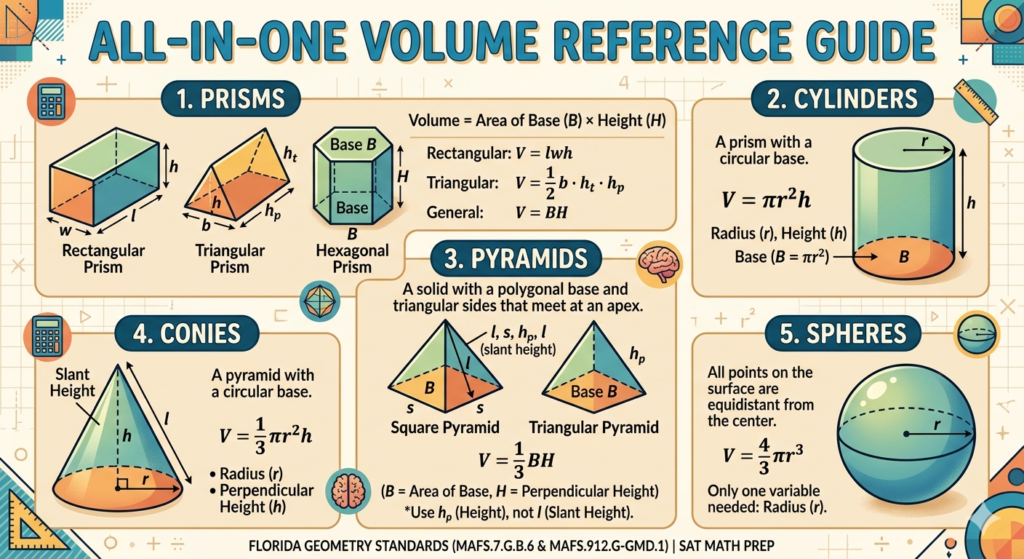
| Tent Shape | Formula | Example |
|---|---|---|
| Triangular Prism | V = (L × b × h) ÷ 2 | (7 × 5 × 6) ÷ 2 = 105 ft³ |
| Cone | V = ⅓πr²h | ⅓π(7²)(24) = 1,231.68 m³ |
| Hexagonal Prism | V = [(3√3 ÷ 2) × s²] × H | 64.95 × 8 ≈ 520 ft³ |
| Rectangular Tent | V = L × W × H | 6 × 4 × 3 = 72 ft³ |
Bookmark this table for fast lookups during homework or trip planning.
Avoid These Five Critical Errors
- Using the wrong height: triangle height and prism length are not interchangeable
- Forgetting to divide by 2: triangle area requires (base × height) ÷ 2
- Using diameter instead of radius: cones need radius, so halve the diameter first
- Mixing units: convert everything to feet or meters before calculating
- Applying the wrong formula: always confirm the shape before choosing a formula
Frequently Asked Questions About Finding the Volume of a Tent
What formula gives the volume of a triangular prism tent?
The standard formula is V = (Base × Height ÷ 2) × Length. A shortcut version is V = (Length × Base × Height) ÷ 2. Both produce the same answer.
How do you calculate the volume of a cone-shaped tent?
Use V = ⅓πr²h. If you only know the diameter and slant height, find the radius first, then apply the Pythagorean Theorem to convert slant height into vertical height.
What units should I use for tent volume?
Always use cubic units, such as cubic feet (ft³) or cubic meters (m³). Square feet measures area, not volume, so it cannot replace cubic feet in a final answer.
How do I find the volume of a tent with a sloped or irregular roof?
Split the tent into simple parts, calculate each volume, then add them together. A hexagonal tent with a sloped roof can be divided into a hexagonal prism and a pyramid, for example.
What is the volume of Devon’s tent if the triangle base is 5 ft, height is 6 ft, and length is 7 ft?
The triangle area is (5 × 6) ÷ 2 = 15 ft². Multiplying by the length gives 15 × 7 = 105 cubic feet.
Key Takeaways for Calculating Tent Volume Accurately
The shape of your tent determines the formula. Triangular prisms use (Length × Base × Height) ÷ 2. Cones use ⅓πr²h and may require the Pythagorean Theorem to find vertical height. Hexagonal prisms use the hexagon area times the height. For hybrid designs, divide the tent into sections and sum the volumes. Always measure in consistent units and confirm the answer with a quick verification step.
Your next step is simple: grab a tape measure, identify your tent shape, and run the numbers. You will know exactly how much space you have for gear, sleep, and movement, and you will be ready for any geometry problem that comes your way.