
You’re planning a camping trip and need to estimate fabric for a custom build. Or maybe you’re working through a geometry homework problem that feels more like real life than math class. Either way, knowing how to find the surface area of a tent gives you the power to calculate material needs, solve problems accurately, and understand the shapes around you. Most standard tents are shaped like triangular prisms, featuring two triangular ends and three rectangular sides (including the floor). The surface area is simply the total material covering the outside, whether you include the floor depends on your specific goal.
In this guide, you’ll learn proven methods to calculate tent surface area even when key dimensions are missing. We’ll cover direct measurements, volume-based calculations, and how to exclude the floor when needed. You’ll also learn to avoid common mistakes, such as confusing internal height with perimeter, and apply the Pythagorean theorem with confidence. By the end, you’ll be able to compute tent surface areas in square feet or meters for school, DIY builds, or outdoor planning.
Identify the Tent as a Triangular Prism

Before calculating anything, confirm your tent fits the triangular prism model. This shape has:
– Two identical triangular ends (front and back)
– Three rectangular faces: two slanted sides and a bottom (floor)
– A consistent cross-section running from end to end
If your tent has vertical walls and a peaked roof, it’s likely a triangular prism. This classification unlocks standard geometry formulas. Curved or irregular tents require different approaches, but those are uncommon in basic models.
Check for Isosceles Triangular Ends
Most tents use isosceles triangles for the front and back panels. These triangles feature:
– A flat base (the floor width)
– Two equal slanted sides rising to a central peak
– Symmetry that simplifies all calculations
Because of this symmetry, you can split the triangle into two right triangles. This allows you to use the Pythagorean theorem to find any missing side lengths. Always verify symmetry before halving the base in your calculations.
Confirm All Dimensions Use the Same Units
Mixing units causes major calculation errors. Ensure every measurement is in feet, meters, or another single unit system. Convert inches to feet (divide by 12) and centimeters to meters (divide by 100) before starting. Label each dimension clearly, especially when comparing multiple tents or solving complex problems.
Use the Surface Area Formula for Prisms

The total surface area of a tent-shaped prism combines all external faces. The standard formula is:
S = P × h + 2B
Where:
– S = total surface area
– P = perimeter of the triangular base
– h = length of the tent (distance between the two triangular ends)
– B = area of one triangular end
This formula works because:
– P × h calculates the lateral (side) surface area
– 2B adds both triangular ends together
Always determine whether the problem includes the floor. Some questions ask for “total” surface area (with floor), while others specify “excluding base” (no floor). Adjust your approach accordingly.
Calculate Perimeter of the Triangular Base
Add all three sides of the triangle:
P = side₁ + side₂ + side₃
For an isosceles triangle with base = 5 ft and slanted sides = 6.5 ft:
P = 6.5 + 6.5 + 5 = 18 ft
Never use internal height here, only the outer edges. This is a frequent mistake that throws off the entire calculation.
Find Area of One Triangular End
Use the standard triangle area formula:
B = ½ × base × height
For a triangle with base = 5 ft and height = 6 ft:
B = ½ × 5 × 6 = 15 ft²
Then double it to account for both ends:
2B = 2 × 15 = 30 ft²
Find Missing Sides Using the Pythagorean Theorem
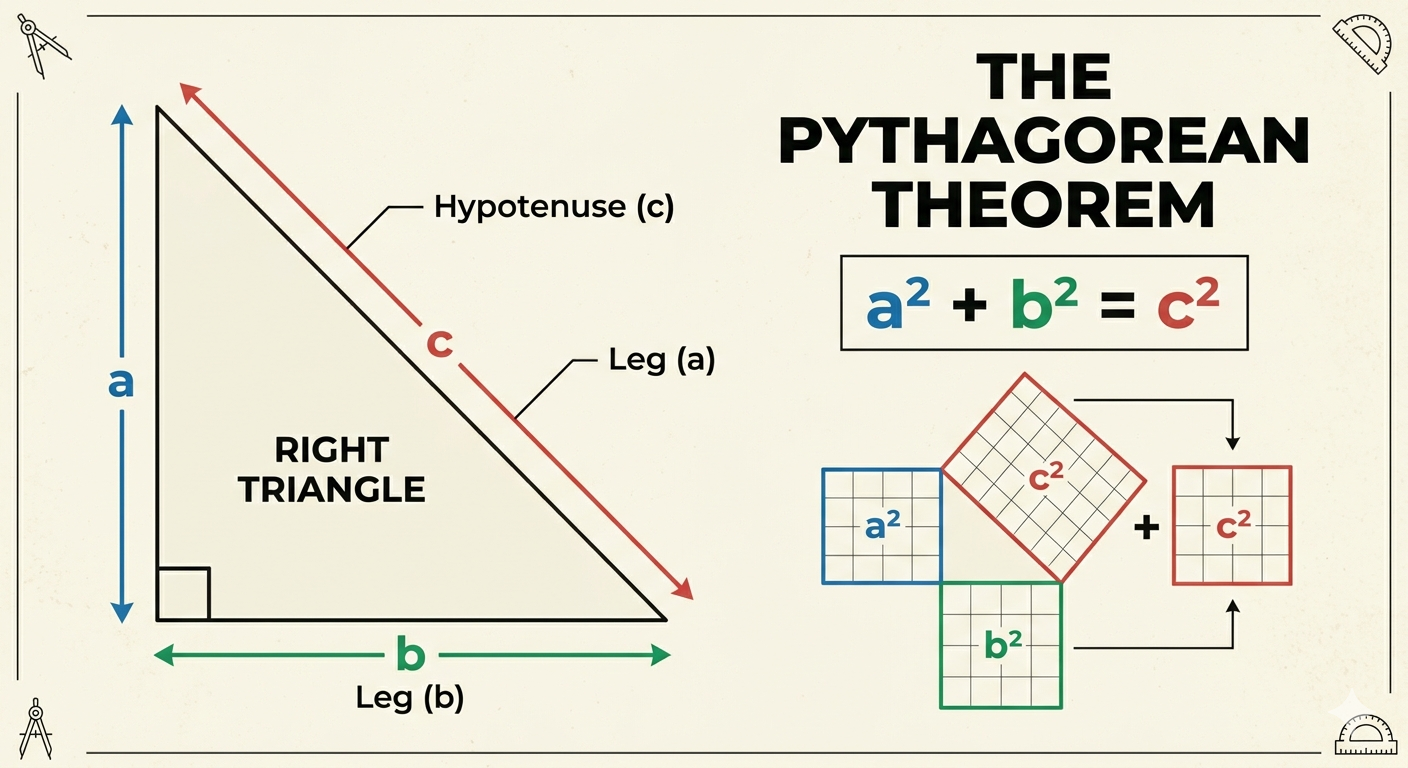
You won’t always have every side length provided. When the slanted side (hypotenuse) is missing, use the Pythagorean theorem:
a² + b² = c²
Split the isosceles triangle into two right triangles. Each one has:
– One leg = half the base
– Other leg = height from base to peak
– Hypotenuse = slanted side of the tent
Solve for the Slant Side Length
Given:
– Half base = 2.5 ft (from a 5 ft base)
– Height = 6 ft
c² = 2.5² + 6² = 6.25 + 36 = 42.25
c = √42.25 = 6.5 ft
Now you can include this slant length in the perimeter calculation.
Find Triangle Height From Slant Sides
Sometimes the height is unknown but slant sides and base are given. Rearrange the formula:
h = √(slant² − (base/2)²)
For slant = 1.8 m and base = 2 m:
h = √(1.8² − 1²) = √(3.24 − 1) = √2.24 ≈ 1.4967 m
Use this height to calculate the triangular end area.
Calculate Lateral Surface Area

The lateral surface area covers the three rectangular sides: two slanted walls and the floor. The formula is:
Lateral Area = P × h
Where:
– P = perimeter of the triangular base
– h = length of the tent
For P = 18 ft and tent length = 9 ft:
18 × 9 = 162 ft²
This includes both slanted rectangles and the floor rectangle. If you need to exclude the floor, subtract its area afterward.
Break Down Individual Rectangular Faces
For better control, calculate each rectangle separately:
-
Slanted side: slant length × tent length
Example: 6.5 ft × 9 ft = 58.5 ft² (per side) -
Floor: base of triangle × tent length
Example: 5 ft × 9 ft = 45 ft² -
Total lateral area: (2 × 58.5) + 45 = 162 ft²
This matches the P × h result, giving you two reliable methods.
Handle Missing Height With Volume Data
When the triangle’s height isn’t given but volume is, work backward using:
Volume = Base Area × Length
Solve for base area first:
Base Area = Volume ÷ Length
For a tent with volume = 60 ft³ and length = 6 ft:
Base Area = 60 ÷ 6 = 10 ft²
Now use the triangle area formula to find height:
10 = ½ × 4 × h → h = 5 ft
With height known, you can find the slant side and complete the surface area calculation.
Apply Volume to Real-World Design
This reverse-engineering method helps determine tent dimensions from space requirements. If you know the enclosed volume needed, you can calculate the height required for headroom or ventilation. It’s useful for custom builds and verifying manufacturer specifications.
Exclude the Floor When Required
Many problems ask for surface area excluding the base, reflecting actual fabric needs since floors often use heavier material.
Identify Which Faces to Include
When excluding the base:
– Include: two triangular ends and two slanted rectangular sides
– Exclude: floor (the rectangle matching base × length)
For a tent with:
– Triangular ends: 1.4967 m² each → total 2.9934 m²
– Slanted sides: 1.8 m × 2.5 m = 4.5 m² each → total 9 m²
Total (no floor) = 2.9934 + 9 = 11.9934 m² ≈ 11.99 m²
Avoid Common Inclusion Errors
One common mistake is adding the floor when the problem says to exclude it. For this example, including the floor (2 m × 2.5 m = 5 m²) would give 16.99 m², which is incorrect. Always re-read the question before finalizing your answer.
Compute Material Needed for Multiple Tents
Once you know the surface area per tent, calculate how many complete tents you can make from available material.
Divide Total Material by Tent Area
Given:
– Available material: 140 m²
– Area per tent (no floor): 11.9934 m²
Number of tents = 140 ÷ 11.9934 ≈ 11.67
But you can’t build a fraction of a tent.
Round Down for Complete Units
Always round down to the nearest whole number:
11 complete tents
Even if your calculation gives 11.9, the answer remains 11. This rule applies to any production scenario involving fabric, cost, or time estimates.
Compare Calculation Methods
Different problems require different approaches based on what’s given.
Method 1: All Dimensions Known
Use when base, height, and length are all provided.
Steps:
1. Find slant side via Pythagorean theorem
2. Calculate perimeter
3. Compute lateral area (P × h)
4. Add both triangular ends (2B)
Result: 192 ft² (includes floor)
Method 2: Volume-Based Height
Use when volume and some dimensions are known.
Steps:
1. Find base area from volume
2. Solve for triangle height
3. Find slant side
4. Sum all face areas
Result: 44 + 12√29 ft² ≈ 108.6 ft²
Method 3: Exclude the Base
Use when calculating fabric coverage without the floor.
Steps:
1. Find triangle height from slant sides
2. Calculate end areas
3. Add only slanted rectangles
4. Omit the floor
Result: ≈11.99 m²
Prevent Common Calculation Mistakes
Avoid these frequent errors:
Confusing Perimeter With Internal Height
Never plug the triangle’s height into the P × h formula. Only the perimeter of the base goes there. The tent’s length is the other multiplier.
Forgetting Units Squared
Surface area is always expressed in square units (ft², m²). Skipping this notation costs points on exams and credibility in reports.
Misreading “Exclude the Base”
Double-check whether the floor should be included. When unclear, assume “fabric-only” means no floor.
Using the Wrong Triangle Base
Ensure you’re using the correct base in area formulas. For an isosceles triangle, the base is the flat bottom, not the slanted side.
Frequently Asked Questions About Finding Tent Surface Area
What formula is used to find the surface area of a tent-shaped prism?
The standard formula is S = P × h + 2B, where P is the perimeter of the triangular base, h is the length of the prism, and B is the area of one triangular end. This covers all rectangular sides plus both triangular ends.
How do you find the surface area of a tent excluding the floor?
Calculate the two triangular ends and the two slanted rectangular sides only. Omit the floor rectangle (base × length). For a tent with 2.9934 m² in triangular ends and 9 m² in slanted sides, the total excluding the base is approximately 11.99 m².
Can you find tent surface area if only the volume is given?
Yes. First find the base area by dividing volume by length, then solve for triangle height using the area formula. Once you have the height, use the Pythagorean theorem to find the slant side and complete the calculation.
What is the difference between lateral surface area and total surface area of a tent?
Lateral surface area (P × h) covers only the rectangular sides, including or excluding the floor. Total surface area (P × h + 2B) adds both triangular ends to the lateral area, giving you the complete outside coverage.
How many complete tents can be made from a given amount of fabric?
Divide total available material by surface area per tent, then round down to the nearest whole number. For example, 140 m² of material ÷ 11.9934 m² per tent = 11 complete tents, even though the decimal is 11.67.
Why is the Pythagorean theorem important for tent calculations?
Most tents have isosceles triangular ends that can be split into right triangles. The Pythagorean theorem lets you find missing slant sides or heights when only base and one other dimension are known.
Final Thoughts on Calculating Tent Surface Area
You now have a complete toolkit for finding tent surface area in any scenario. The key takeaways are: tents are triangular prisms, the formula S = P × h + 2B is your foundation, and the Pythagorean theorem solves almost every missing-dimension problem. Always check whether the floor should be included, and remember to round down when counting complete tents from limited material.
Whether you’re solving geometry homework, planning a DIY tent build, or estimating fabric costs for a camping project, these methods give you reliable results. Start by identifying what dimensions you have, choose the matching method, and work through each step carefully. With practice, these calculations become second nature for any tent-related challenge.