
How fast should you hike? The answer isn’t a one-size-fits-all number. While many hikers assume they’ll move at a steady pace, average hiking speed typically falls around 2 miles per hour—and that includes stops, elevation gain, and rough terrain. But in reality, your actual pace can swing from less than 1 mph on steep mountain ascents to over 4 mph on smooth, flat trails. Whether you’re planning a day hike in the Rockies or training for a long-distance thru-hike, knowing your realistic speed is crucial for safety, timing, and enjoyment.
This guide breaks down average hiking speed using real-world data, expert formulas, and firsthand reports from thousands of hikers. You’ll learn how terrain, elevation, fitness, pack weight, and group dynamics affect your pace—and how to plan hikes with confidence using accurate time estimates. Stop guessing how long a trail will take. Start calculating.
Most Hikers Average 2 mph—But It Varies Widely
The widely accepted baseline for hiking speed is 2 miles per hour, but this isn’t your moving speed—it’s your overall average, factoring in breaks, elevation, and trail conditions.
- Typical range: 1.5 to 3.5 mph
- Fast hiking (flat, easy trails): Up to 4 mph
- Slow hiking (steep, rugged terrain): Below 1 mph
“I really average 2 mph for a day’s hiking, including breaks and hills.” – Kevin Babione, experienced backpacker
This 2 mph rule works because it reflects real-world conditions: snack stops, photo breaks, navigation pauses, and fatigue. If you’re moving at 3 mph but stop for 10 minutes every hour, your average drops to around 2.5 mph. Add steep climbs, and it can easily fall to 1.8 mph or lower.
For accurate planning, always use overall average speed, not your fastest walking pace.
Hiking Speed by Terrain: From Forest Roads to Alpine Scrambles
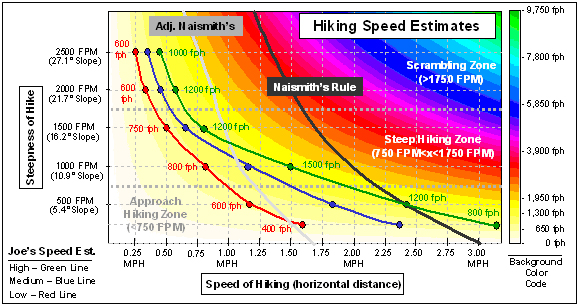
Terrain is the single biggest factor affecting hiking speed. A well-maintained forest road allows fast progress, while a rocky alpine trail can slow you to a crawl.
| Terrain Type | Speed (mph) | Time per Mile |
|---|---|---|
| Forest road / tractor road | 2.9 | 21 min |
| Easy, flat trail | 2.5 | 24 min |
| Gently rolling | 2.1 | 29 min |
| Hilly terrain | 1.7 | 35 min |
| Steep ascent | 1.2 | 50 min |
| Very steep ascent | 0.9–1.0 | 60–67 min |
On a steep climb with 1,000+ feet of gain per mile, even fit hikers may average under 1 mph. Conversely, on flat, open paths, many can sustain 3–4 mph with minimal effort.
“On very steep hikes (1000+ ft/mile), I barely make 1 mph.” – xahvres, backcountry hiker
Off-Trail and Dense Forest Speeds Drop Dramatically
Once you leave marked trails, speed plummets due to obstacles, route-finding, and unstable footing.
- Light forest: 1–2 mph
- Dense brush: 0.5–1 mph
- Swamps or thickets: < 0.5 mph
- Game trails: Often unusable or dangerous
One hiker reported covering just 400 meters (0.25 miles) in one hour through untracked forest. Off-trail hiking demands doubled time estimates and expert navigation skills.
How Elevation Gain Slows You Down

The 1,000-Foot Rule: Add 30–60 Minutes Per 1,000 Feet
Every 1,000 feet of elevation gain adds 30 to 60 minutes to your hike—even if the distance is short.
For example:
– A 3-mile flat trail: ~1 hour at 3 mph
– A 3-mile trail with 2,000 ft gain: ~3+ hours
This slowdown is especially pronounced above 7,000 feet, where oxygen levels drop and endurance suffers.
“At altitude, I average 2 mph all day. At sea level, I’d add 0.5–1 mph.” – Paul McLaughlin, Sierra hiker
Vertical Ascent Rates: How Fast Can You Climb?
Elite hikers can ascend at 22 meters per minute (72 ft/min), but this is near physical limits. Most average:
- 8–11 m/min (26–36 ft/min): Steady, sustainable pace
- 13–15 m/min (43–50 ft/min): Fast, trained hikers
- >15 m/min: Near maximum effort
A rate of 2,000 ft/hour means you’re moving quickly—about 3 mph on a 12% grade.
6 Key Factors That Reduce Your Hiking Speed
Heavy Pack Weight Slows You Down
Every extra pound increases fatigue and reduces speed.
| Pack Weight | Speed Impact |
|---|---|
| < 10 lbs (ultralight) | Minimal slowdown |
| 20–30 lbs (average) | –0.5 to –1 mph |
| > 30 lbs (heavy) | –1+ mph, more breaks |
“I lose about 1 hour of walking per day for every 10 pounds on my back.” – Stephen Owens
Carrying a full resupply pack? Expect slower days and earlier fatigue.
Fitness Level Determines Sustainable Pace
Your fitness directly controls how fast you can hike over long distances.
| Fitness Level | Average Speed |
|---|---|
| Beginner / low fitness | 1–1.5 mph |
| Moderate fitness | 2–2.5 mph |
| Experienced hiker | 2.5–3.5 mph |
| Thru-hiker elite | 3.0–3.5 mph (moving) |
After months on the trail, many hikers improve from 2.0 to 3.0 mph moving speed.
“After 500 miles on the PCT, I do almost exactly 3 mph while moving.” – Stephen Adams
Breaks and Sightseeing Cut Average Speed
Even if you walk fast, breaks pull down your overall pace.
- Moving speed: 3.0+ mph
- With breaks: Drops to 2.0–2.5 mph
- With long stops: Can fall below 1.5 mph
Snacks, photos, wildlife, and navigation all add up. A 10-mile hike with frequent stops may take 6–8 hours even at a brisk walking pace.
“I walk 2.5–3 mph but take enough breaks to average 2 mph.” – Trevor Wilson
Altitude Lowers Performance
Above 7,000 feet, oxygen thinning reduces stamina.
- 7,000–10,000 ft: –0.5 to –1.0 mph
- Above 10,000 ft: 1.0–1.5 mph (especially uphill)
Acclimatization helps—speed improves after 5–7 days at elevation.
“At higher elevations (above 10k), all bets are off.” – Hiking Malto
Group Hiking Moves at the Slowest Pace
Groups hike as fast as their slowest member.
- Solo hiker: Faster, consistent pace
- With kids or elderly: 1–1.5 mph
- With dogs: Varies—sniffing slows progress
“With kids: 1–1.5 mph. Without kids: 3–3.5 mph.” – Admirable-Variety-46
Always plan around the slowest person—or expect long waits.
Use Proven Formulas to Plan Your Hike Time
Naismith’s Rule: The Gold Standard for Time Estimation
Developed in 1892, this classic rule estimates hike duration based on distance and elevation.
Rule:
– 1 hour per 3 miles (5 km)
– +1 hour per 2,000 ft (600 m) of ascent
Example:
A 6-mile hike with 2,000 ft gain = 2 hours + 1 hour = 3 hours
“Naismith’s Rule gets me close every time.” – Article 2
Scarf’s Equivalence: Convert Climb into Flat Miles
This model converts elevation gain into “equivalent flat distance” using a multiplier.
- Formula: equivalent distance = horizontal distance + (7.92 × vertical distance)
- Often simplified to 8:1 ratio (8 flat miles = 1 mile of climb)
Example:
20 km with 1,600 m climb → 20 + (1.6 × 8) = 32.8 km
At 5 km/h, that’s 6h 34min
This helps compare hikes with different elevation profiles.
Tranter’s Corrections: Adjust for Fitness
Modifies Naismith’s Rule based on your fitness level.
| Fitness (climb 1,000 ft in ½ mile) | Time Multiplier |
|---|---|
| 15 min (very fit) | ×0.8 |
| 20 min | ×1.0 |
| 25 min | ×1.3 |
| 30 min | ×1.7 |
| 40 min | ×2.4 |
| 50 min (unfit) | ×3.0 |
If Naismith says 9 hours and you’re moderately fit (25 min), plan for 11.5 hours.
Aitken & Langmuir Updates
Aitken (1977):
– 3 mph on paths
– 2.5 mph on rough terrain
– +1 hour per 2,000 ft ascent
Langmuir (1984):
– Base: 5 km/h + 1h / 600 m ascent
– Downhill adjustments:
– Gentle decline: –10 min per 300 m
– Steep decline: +10 min per 300 m (due to caution)
Langmuir also suggests 4 km/h + 1h / 450 m for groups.
Real-World Hiking Speed Examples
Day Hike Speeds
| Hike | Distance | Elevation | Time | Avg Speed |
|---|---|---|---|---|
| Moderate 5-mile trail | 5 mi | 400 ft | 2.5 hr | 2.0 mph |
| White Mountains, NH | 8–16 mi | — | 8 hr | 1.5 mph (moving) |
| Olympus, Greece | 8.07 mi | ~4,600 ft | 3h 30min | 2.2 mph |
| Grand Canyon R2R2R | 45 mi | ~10,000 ft | 16.5 hr | ~2.7 mph (rolling) |
Even experienced hikers average 1.0 mph in extreme terrain like the Presidential Range (16+ miles, 4,000 ft gain, 16 hours).
Thru-Hiking Speeds
| Trail | Daily Mileage | Avg Speed | Notes |
|---|---|---|---|
| Appalachian Trail | 15.5 mi/day | 1.94 mph (8 hrs) | Average thru-hiker |
| Pacific Crest Trail | 25–30 mi/day | 2.75–3.0 mph (moving) | Fast pace |
| John Muir Trail | 20+ mi/day | 2.0 mph (with breaks) | Includes lunch/rest |
Most PCT hikers sustain 3 mph while moving, averaging 2.5–3.0 mph overall with breaks.
“Most PCT hikers go 3 mph and do 25–30 miles a day.” – Article 1
How to Measure and Improve Your Hiking Speed
Use GPS Tools for Accuracy
| Method | Accuracy | Best For |
|---|---|---|
| GPS Watch (Garmin) | High | Precise pace, elevation, auto-pause |
| Strava / AllTrails | Medium–High | Segment analysis, sharing |
| Fitness Trackers | Medium | General tracking |
| Manual (time ÷ distance) | Low–Medium | Basic estimates |
Track 3–5 hikes to establish your personal average.
How to Increase Your Hiking Speed

Train for Endurance and Strength
- Cardio: Running, cycling, stair climbing
- Leg strength: Squats, lunges, hill repeats
- Core stability: Prevents fatigue on long descents
- Threshold walking: Sustain fastest walk for 30–60 min
“Emphasized strength over speed—walking with weight. Once strength is built, speed follows.” – RenegadeBS
Lighten Your Pack
- Day hikes: < 20 lbs
- Backpacking: < 30 lbs (ultralight: < 15 lbs)
- Efficient load distribution: Prevents imbalance and strain
“With my ultralight pack, it doesn’t matter if it’s a 4-day hike or a day hike.” – Stephen Adams
Optimize Pacing and Breaks
- Steady effort, not constant speed: Slow uphill, speed on flats
- Short, frequent breaks: 5–10 min every 45–60 min
- Avoid long stops: >15 minutes can cause stiffness
“I keep energy expenditure constant—slow uphill, faster on flat.” – Kevin Babione
Practical Rules of Thumb for Planning
| Condition | Speed | Time per Mile |
|---|---|---|
| Flat trail | 3–4 mph | 15–20 min |
| Moderate trail | 2–2.5 mph | 24–30 min |
| Steep or rugged | 1 mph | 60 min |
| With kids or pets | 1–1.5 mph | 40–60 min |
| Off-trail | 0.5–1.0 mph | 60–120 min |
Bonus Tips:
– Double AllTrails’ estimate if hiking with kids or heavy pack
– Add 30 min per 1,000 ft of elevation gain
– Plan to finish before dark—overestimate time for safety
“Whatever AllTrails says, I double the time.” – Beyond1nfinity
Final Takeaways
- Most hikers average 2 mph—including breaks and hills
- Elevation, terrain, and pack weight are the biggest speed killers
- Use Naismith’s Rule or Scarf’s model for accurate planning
- Track your speed with GPS to refine estimates
- Pace for conversation, not speed—hiking is about the journey
Whether you’re a beginner or a seasoned thru-hiker, understanding average hiking speed helps you plan safer, more enjoyable trips. Stop guessing—start calculating.